
News New net-metering photovoltaic system at the Laboratoire d’Energie Solaire at the University of Lomé
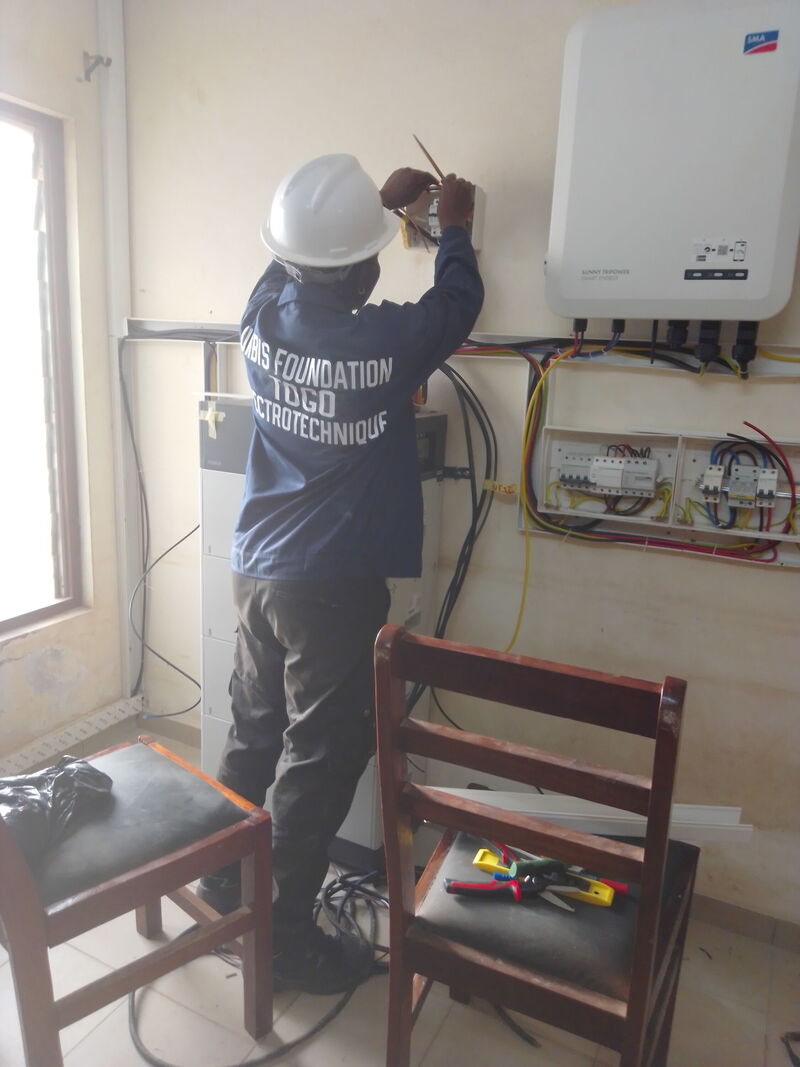
Solar power for everyday university operations and a new practical platform for research and training: In July 2026, a new 6.75 kWp net-metering photovoltaic system was installed at Laboratoire d’Energie Solaire (LES) of Universität Lomé.
Under the leadership of Tchabi Taofidatou, Head of the Solar Sector at the Urbis Foundation, the system was installed together with the team of M. Alaba from IENIB in Sokodé. The photovoltaic modules, inverters, batteries and protection components were installed and connected to the building’s main electrical distribution system. A bidirectional meter allows the solar power generated to be used directly by the laboratory, while surplus electricity is fed into the public CEET grid. A monitoring system records the system’s electricity production and feed-in data.
The first results show stable performance: during the initial operating phase, the system generated an average of around 27 kWh of solar electricity per day. By 17 August 2026, 888 kWh had already been fed into the public grid. Annual electricity production is expected to reach approximately 6,700 to 9,500 kWh. According to current estimates, the system can avoid around 650 kg of CO₂ emissions per year.
With the start of the new university semester, additional electrical appliances will be connected to the system. Energy-intensive equipment should preferably be operated during the sunniest hours, between 11 a.m. and 3 p.m., to increase the direct consumption of solar electricity. At the same time, the real-time operating data will make it possible to analyse how different consumption patterns affect the use and economic efficiency of a net-metering system.
The monitoring system also provides a valuable basis for research and training. Students and researchers can analyse electricity production, on-site consumption and grid feed-in, gaining practical experience with photovoltaic systems and net metering. The experience gained during installation, including the technical configuration, WLAN connections and the conditions of the public electricity grid, can also inform future projects.
The new 6.75 kWp system therefore contributes to a more sustainable energy supply at Universität Lomé while creating a practical environment for research, training and the further development of solar energy solutions in Togo.